Emergency Procedures
The Fielding School of Public Health strives to maintain a safe environment for its students, faculty, staff and visitors. We do our best to minimize risk, but we also must be realistic and plan for emergencies that happen without warning.
Information You Need in an Emergency
TO REPORT ANY EMERGENCY
(Police, Fire, Ambulance):
|
911 |
Immediate Response to Health and Safety Issues |
|
(310) 825-1491 |
UCPD Dispatch |
|
(310) 825-9236 |
Report Damage to Physical Plant |
Emergencies may also be reported using emergency phones at various locations on campus.
For Information in a Major Emergency:
|
1-800-900-UCLA |
Recorded Campus Emergency or Information |
|
(310) 206-7994 |
Environmental Health and Safety Hotline |
|
(310) 825-3212 |
UCPD Recorded Information |
|
UCLA Website |
|
|
UCLA Office of Emergency Management |
Stay Connected
Receive real-time campus alerts through BruinALERT
Download Bruins Safe app for reporting and safety resources.
Be Prepared
Emergency Procedure Checklists
Please review the checklists below to become better prepared.
-
FIRE
IN THE EVENT OF A FIRE
- Call for help. Dial 911 or (310) 825-1491.
- Follow RACE:
- Relocate: Be aware of those who may need immediate assistance and guide people away from danger.
- Before opening any door, feel doorknob with the back of your hand. If hot, do not open.
- Alarm: Pull fire alarm to alert others. Call 911 immediately; then, call Facilities Management to report exact location of fire/smoke.
- If alarm fails to operate, warn nearby occupants by knocking on doors and shouting warnings only if safe and time permits.
- Confine: Close doors (do not lock) as you exit if it is safe to do so. Shut off fuel sources such as piped or bottled gas, only if safe and time permits.
- Evacuate: Leave the building and move towards your assembly area. Do not use the elevator. Alert emergency responders of individuals who are trapped or unaccounted for.
If You Hear a Fire Alarm:
-
When a building fire alarm is activated, never assume it is a false alarm. Everyone must exit the building.
-
If there is smoke in the hallway as you exit, stay low to the floor.
If You Are Trapped Inside a Room by Fire:
If you hear a fire alarm and you are inside a room, feel the door before opening it. If it is hot, do not open it. Fire may be in the hallway. If you must, remain inside the room:
- Call UCPD Dispatch, tell them your location and that you need Fire Department assistance to get out.
- Seal up the bottom of the door with cloth to prevent smoke from entering.
- Retreat. Close as many doors between you and the fire as possible.
- If you need air and the windows are operable, open the window. Break windows only as a last resort.
- Hang light-colored material out the window to attract the attention of rescue teams below if possible.
Fire Extinguishers
Use a fire extinguisher only if you have been trained in how to use it, and only if the fire is very small. Before attempting to extinguish a fire, sound the alarm and call for help. As you extinguish the fire, stay between the fire and the exit.To use a fire extinguisher, remember PASS:
P PULL the pin from handle.
A AIM the extinguisher nozzle at the base of the fire.
S SQUEEZE the handle to begin the flow of extinguishing material.
S SWEEP the nozzle slowly from side to side.
-
EVACUATION PLAN
BUILDING EVACUATION
- Everyone must leave the building immediately if the fire alarm is activated or if directed to do so by a Safety Officer.
- To exit the building, use the nearest safe exit or exit stairwell. Never use elevators in an emergency evacuation.
- If the nearest exit or exit stairwell is obstructed by smoke, fire or other hazards, proceed to another exit or exit stairwell.
- During stairwell evacuation, hold the handrail, and stay to one side of the stairwell. Allow enough room for others to enter the flow of traffic.
- Exit the CHS structure through the nearest designated exit that allows for a safe exit.
- As conditions permit, proceed to the Fielding School of Public Health assembly area of the North sidewalk on CEY South. For offices in the Life Sciences Building, proceed to the Science Quad Assembly area.
- Do not re-enter the building until given the “all clear” by emergency personnel.
- Take time now, prior to an emergency, to identify alternate paths to exit the building, noting the location of all stairwells.
- Always keep corridors and hallways clear so as not to impede evacuation.
EMERGENCY EVACUATION FOR PEOPLE WITH DISABILITIES
In the event of a building evacuation, some individuals with disabilities may require special assistance. Everyone can help by becoming aware of those who may need assistance.
Mobility-Impaired/Wheelchair
For wheelchair users on upper floors, assistance normally will be provided by trained Fire Department personnel. Building occupants should remain with the disabled person in a room with an exterior window, a telephone, and a solid door. Send someone out to notify emergency personnel of the location of the person in need of assistance. Fire Department personnel can then assist the person. Only when the Fire Department is not available and there is an imminent hazard should occupants evacuate wheelchair users. If this must be attempted, one technique is the two-person cradle carry:
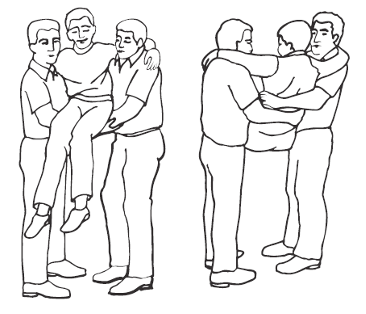
- With a second person, wait until other evacuees have moved down the stairwell.
- Both of you stand on either side of the individual.
- Reach under the individual and lift them out in a cradle.
- Control the descent by walking slowly and cautiously.
- Never leave the wheelchair in a stairwell.
Hearing Impaired
People with hearing impairments may not hear audio emergency alarms and will need to be alerted by other building occupants.
Visually Impaired
People who are visually impaired may need assistance in evacuating. The assistant should offer his/her elbow to the individual with a visual impairment and guide him/her through the evacuation route.
-
EARTHQUAKE
IN THE EVENT OF AN EARTHQUAKE
A major earthquake may cause damage and injuries throughout southern California, and many emergencies on campus. In the event of a major earthquake that causes strong shaking:
- Drop, cover and hold on. Protect yourself from falling objects such as light fixtures or bookcases. Stay away from windows. Get under a table or desk or stay in an area free of falling hazards.
- Do not stand in a doorway. Doorways offer no greater protection than any other area.
- If outside, move away from structures, power poles, or other possible hazards. Stay in an open area.
- During the shaking, do not run for exits or attempt to leave the building. Walking may be difficult and heavy objects may fall in your path.
- When the shaking stops, be prepared for aftershocks. Check the people around you for injuries; provide first aid. Do not move seriously injured persons unless they are in immediate danger of a gas leak, hazardous material spill, fire or falling debris.
- Evacuate if it is safe to do so and proceed to your designated area.
- Check the BruinAlert or Bruinsafe App or listen to local radio stations.
EMERGENCY RESPONSE KIT
Everyone should have a personal emergency kit in case of earthquake or other disaster. This kit should contain essentials to ensure survival for 72 hours, including:
❖ Water and non-perishable food to sustain you for three days. If canned food is used, include a can opener
❖ Emergency space blanket
❖ First aid supplies
❖ Personal medication and extra eyeglasses
❖ Portable AM/FM radio (spare batteries or hand crank)
❖ Flashlight (spare batteries or hand crank)
❖ Money (small amount)
❖ Work gloves (optional)
❖ Close toed shoes
❖ List of essential phone numbers, including an out-of-state family contact number
-
MEDICAL EMERGENCY
IN THE EVENT OF A MEDICAL EMERGENCY
[In all life threatening or severe emergencies, call 911]
- Call 911 or UCPD Dispatch (310) 825-1491 to request assistance.
- Provide the location, nature of injury or illness, and the victim’s current condition. Appropriate medical assistance will be dispatched immediately.
- If possible, provide information about the age and sex of the victim, and any known medical history.
- Stay with the victim. Do not move the victim unless either of you are in immediate danger of further injury.
- If the injured person is a university employee, the supervisor must notify Risk Management at (310) 794-6948.
OBTAINING MEDICAL ATTENTION
- Severe emergencies
- Call 911 or visit the Ronald Reagan Medical Center emergency room
- Medical treatment (non-emergency):
- Employees/students: see the Ashe Center website for location and hours
- Employees: see Occupational Health website for location and hours
- For research animal-related injuries, visit Occupational Health
*Keep a first-aid kit in desk or office.
-
BOMB THREAT/SUSPICIOUS PACKAGE/SUSPICIOUS PERSON
IN THE EVENT OF A BOMB THREAT
Get as much information as possible from the caller and report the threat immediately to UCPD Dispatch (310) 825-1491.
- If you receive a bomb threat, respond immediately and do not assume it is a prank or joke
- Stay calm and try to get a colleague’s attention to listen in on the call with you
- The exact time of the call
- The caller’s exact words (pay close attention to details)
- Take note of any noticeable characteristics of the caller
- Take note of any information about the explosive device or its location
- Questions to ask (any order):
- What is your name?
- Where are you located? What is your address?
- When will it explode?
- Where is the bomb right now?
- What does it look like?
- What kind of bomb is it?
- Did you place the bomb?
- Who is the target?
- Why did you place it?
[If the situation is life-threatening, leave immediately and call 911]
- Do not physically confront the individual.
- Do not let any suspicious person into a locked building or office.
- Do not block the person’s access to an exit.
- Notify UCPD Dispatch (310) 825-1491.
-
HAZARDOUS MATERIAL SPILL
IN THE EVENT OF A HAZARDOUS MATERIAL SPILL OR RELEASE
In the event of a spill or release of hazardous material in a laboratory or other location:
- Faculty, staff and students should not attempt to clean up hazardous spills.
- Notify UCPD Dispatch (310) 825-1491. They will dispatch officers and summon the university’s hazardous materials response team.
- When emergency responders arrive, provide detailed information on the spill or release.
Always notify the Environment, Health & Safety Office (310) 825-9797 of any hazardous materials spill, even if small.
-
FLOOD
IN THE EVENT OF A FLOOD
- Proceed with caution; electric shock may occur in flooded areas
- Call 911 and report the flood
- Provide the location (including building and room number), your contact, emergency details and source (if known)
- If safe to do so, meet the responders to report the contents in or around the flooded area, ways to enter the area safely and hazardous or unknown conditions
- If the affected area is a laboratory or hazardous materials are involved, call 911 and evacuate if necessary
- Alert supervisor of incident
- Assist in cataloging damaged assets
- Large Floods
- Flash flood warning issued or if anticipated
- DO NOT EVACUATE, unless safe to do so
- Move to higher grounds, away from water sources
- Leave your car if it stalls. Climb to high ground immediately
- DO NOT try to walk, swim or drive through water
-
ACTIVE SHOOTER
IN THE EVENT OF AN ACTIVE SHOOTER
Utilize this standard practice to ensure you and your colleagues escape safely:
- RUN - if it’s safe and you know where the shooter is
- Getting away from the shooter or shooters is the top priority
- Leave your belongings behind and get away
- Help others escape, if possible, but evacuate regardless of whether others agree to follow
- Warn and prevent individuals from entering an area where the active shooter may be
- Call 911 when you are safe, and describe shooter, location and weapons
- HIDE - in lockdown if you cannot run
- Get out of the shooter’s view and stay very quiet
- Silence all electronic devices and make sure they won’t vibrate
- Lock and block doors, close blinds and turn off lights
- FIGHT - with every means available if confronted by the shooter
- Commit to your actions and act as aggressively as possible against the shooter
- Be prepared to cause severe or lethal injury to the shooter
- Throw items and improvise weapons to distract and disarm the shooter
Trapped with the Shooter
- Don't do anything to provoke them; if they are not shooting, do what they say and avoid sudden movements
- If possible, call 911, if you cannot speak with dispatch, leave the phone line open so the police can hear what is going on
- If they begin shooting, you need to make a choice: stay still/play dead, run for an exit while zigzagging, or attack the shooter
- When police officers arrive, keep your hands up and open and follow police instructions
In Office/Lab
- STAY THERE, lock the door and turn off the lights; stay low and be quiet
- If the door has no lock and the door opens in, use a heavy door wedge; otherwise, use heavy furniture to barricade the door
- If the door has a window, cover it
- If the police have not arrived, move away from the incident, find safe cover positions (avoid parking lots) and wait for the police to arrive
- When police officers arrive, keep your hands up and open and follow police instructions
In Hallways or Corridors
- Enter the closest room and barricade it
- Unless very close to an exit, do not run through a long hall to get to one; you may encounter the assailant
- When police officers arrive, keep your hands up and open and follow police instructions
In Large Rooms/Auditoriums
- Stay there and barricade if possible; turn off all lights, silence phone and remain quiet
- When police officers arrive, keep your hands up and open and follow police instructions
Open Spaces
- Stay alert and look for appropriate cover locations
- Use hardcovers, such as brick walls, large trees, retaining walls, parked vehicles and any other object that may stop bullets
- When police officers arrive, keep your hands up and open and follow police instructions
-
SHELTER-IN-PLACE
SHELTER-IN-PLACE
In some unusual situations, it may be necessary to remain inside the building rather than evacuate. Examples include civil disturbance, active shooter, or incident involving chemical or other weapons on campus. If you become aware of such a situation:
- Stay indoors
- Choose a room in which exterior doors and windows close completely or move to an interior room away from windows
- Stay inside the room until you have received an “all clear” via BruinAlert (check Bruins Safe if online)
For more information on these or other emergency procedures, visit the Office of Emergency Management website.
UCLA Fielding School of Public Health
650 Charles E Young Dr S, Los Angeles, CA 90095
Phone: 310.825.6381