A Passion for Public Health, A Power to Change State Policy
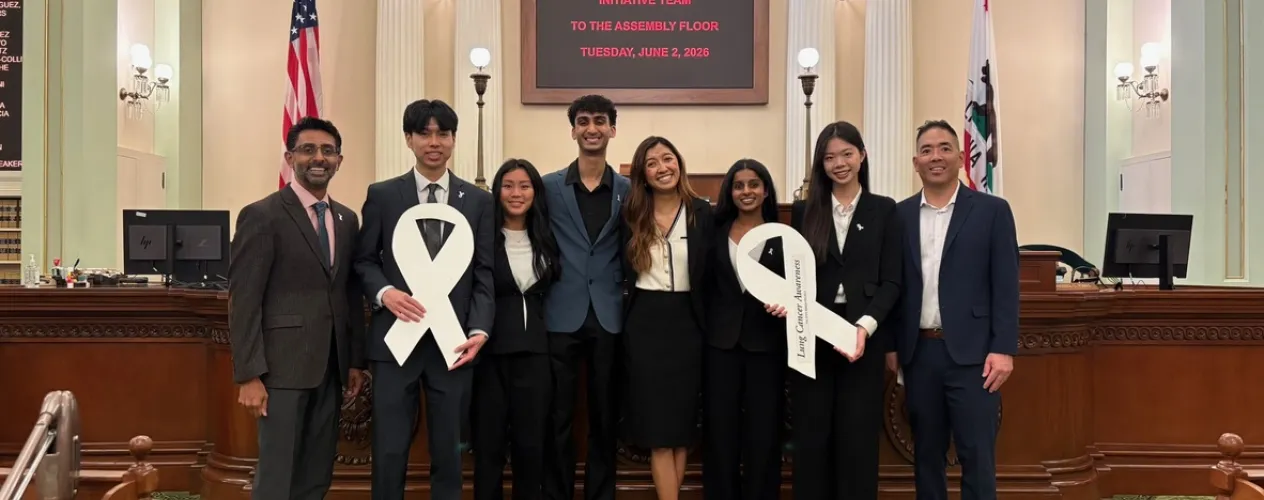
On weekends, Miah Chao was among the undergraduate volunteers who, through their membership in the UCLA chapter of the nonprofit American Lung Cancer Screening Initiative (ALCSI), would participate in community outreach events to raise awareness of the value of lung cancer screening for eligible individuals. Chao had become increasingly committed to advancing community health as a public health major, 2025-26 UCLA Fielding School of Public Health Undergraduate Student Ambassador, and co-director of UCLA’s ALCSI chapter.
Since 2021, the U.S. Preventive Services Task Force has recommended an annual low-dose computed tomography (LDCT) scan for adults ages 50-80 considered to be at high risk for lung cancer, which is defined as having at least a 20-pack-year smoking history and either currently smoking or having quit within the past 15 years. (Pack years are determined by multiplying the average packs of cigarettes smoked per day by the number of years a person has smoked.) The guideline is based on data showing that early detection through LDCT, along with treatment, reduces lung cancer deaths by approximately 20%.
But with many individuals unaware they qualify — or even that lung cancer screening is offered, and is potentially life-saving — fewer than one in five eligible U.S. adults is screened. California ranks 48th out of the 50 states, with only 16% of eligible individuals getting screened, according to the American Lung Association.
Realizing the limitations on the number of people they could reach through community events, Chao and three of her fellow UCLA students set out to make a greater impact through policy change. “We learned that ALCSI’s national advocacy team was interested in pursuing legislation,” Chao recalls. “As students, we had no experience with the legislative process, but we’re passionate about this issue so we decided to see what we could do.”
When California Governor Gavin Newsom signed Senate Bill 1124 into law on September 28, 2026, it culminated nearly two years of tireless efforts led by four UCLA students and ALCSI volunteers: Chao, now a fourth-year public health major; Elaine Dong, a third-year psychobiology major; Ethan Chen, a 2026 graduate in molecular, cell & developmental biology; and Gianna Reyno, a 2025 graduate in human biology & society. The law, which takes effect January 1, 2028, requires tobacco retailers to display signage created by the California Department of Public Health at the point of sale, informing customers about lung cancer screening as well as tobacco-cessation resources. It is the first law of its kind in the nation.
Chao and her UCLA student peers played a hands-on role at every step of the process — from conceptualizing the bill and conducting research and a cost/benefit analysis to bolster their case, to meeting with state legislators and their staff in an effort to find a primary author, recruiting organizations willing to provide testimony on the bill’s merits, and coordinating an in-person advocacy day in Sacramento.
California has more than 23,000 tobacco retailers, which is where most smokers purchase their products, Chao notes. Given that so few eligible individuals are aware of the availability or benefits of screening, “point-of-sale signage is a great way to reach the target population where they are and amplify our message,” she says.
The students also hoped to address the stigma associated with lung cancer. Because smoking is a leading risk factor, individuals diagnosed with the disease are often blamed for their fate, Chao explains, and lung cancer lacks the advocacy community seen with diseases such as breast cancer. The law aims to shift that narrative, normalize screening, and remove judgment. “It’s important for people to know that smoking is bad for their health, but they are already getting that messaging,” Chen says. “We also want to let people know, in a positive way, about resources available to help them take action for their health.”
The journey began with a Zoom brainstorm in February 2025. ALCSI’s national advocacy team had spearheaded the drive to introduce similar legislation in Massachusetts that didn’t pass, but left the UCLA students with a blueprint, including language they tailored for California. The deadline for introducing bills for that year’s legislative session had just passed, so the students spent much of 2025 reaching out to California Assembly and Senate offices in an effort to find a legislator willing to author and introduce the bill in the 2026 session. Chao estimates that the students held 50 Zoom meetings. “It was discouraging at times, because a lot of people said no,” she says. “But we all pushed each other to stay accountable and continue to move forward.”
Just before the February deadline for bill introduction in the 2026 session, the students were notified that California State Senator Bob Archuleta would introduce and champion the legislation. That began the process of committee hearings, votes, amendments, and more uncertainty. At different points, both the Assembly and Senate appropriations committees placed the bill in the “suspense file” for further fiscal evaluation — a step that often spells a bill’s demise without a floor vote.
In August, just before the deadline for legislation to reach the governor’s desk, the bill was taken out of suspense and passed both chambers with overwhelming support. It was formally presented to Governor Newsom on September 3; he signed it into law September 28, two days before the deadline. “When we found out, we all got on FaceTime,” Chao says. “We were in shock. There were a few tears, and many smiles.”
The students are quick to credit those who provided guidance and expertise throughout, both on the issue and on the legislative process. “This initiative was started and empowered by students and it shows that you can make it happen without any prior experience or expertise, as long as you have a passion and the vision to carry it through,” Dong says. “But we were also proactive in reaching out to resources at UCLA, including professors and staff, as well as faculty at other institutions, and they gave us invaluable advice and feedback every step of the way.”
Chao was first exposed to the power of public health as a high school freshman in the San Francisco Bay Area. A family history of addiction led her to become involved in Friday Night Live, a youth-led organization focusing on preventing substance use, promoting mental wellness, and building leadership and advocacy skills. Chao coordinated with the Solano County Public Health Department and spoke in front of her city council, advocating for ordinances to prevent smoking in multi-unit housing and for stricter tobacco retail licensing laws.
Upon entering UCLA as a pre-med student, Chao’s interest in promoting health equity and community engagement naturally drew her to the public health major. Learning more about the field through PH 50A and B, the introductory course series then taught by Dr. Robert Kim-Farley, a UCLA Fielding professor and physician with a long career as a public health leader, Chao’s career aspirations were altered. “I was so excited to realize that I could combine my interests in medicine and public health,” she says. Lessons from other courses on community-engaged research, structural factors that promote disparities, and the impact of health policies only cemented her interest. “My UCLA Fielding professors have been some of the most dedicated and inspiring individuals I’ve ever met,” Chao says.
Even after the signing into law of SB 1124, the work of Chao and her student peers isn’t complete. They hope to collaborate with the California Department of Public Health on its implementation, helping to determine the most effective ways to reach the population through the signage and distribution to retailers. They are also working with ALCSI student chapters in other states in an effort to build on the momentum of California’s passage to introduce similar legislation elsewhere in the country.
As for Chao, who is set to graduate next June, she plans to take a gap year during which she will continue with her lung cancer advocacy while applying to medical schools. Ultimately, she intends to pair her MD with an MPH.
“Before this experience, I had no idea undergraduates could have this type of policy influence,” she says. “It’s a testament to the power of student advocacy, especially in the public health field.”