Teams from California, Maryland, Minnesota, and Ohio take home wins in UCLA Fielding School-UCLA Health competition
Teams from across the U.S. competed in the 7th annual “Healthcare Management Case Competition” hosted by the UCLA Fielding School of Public Health.
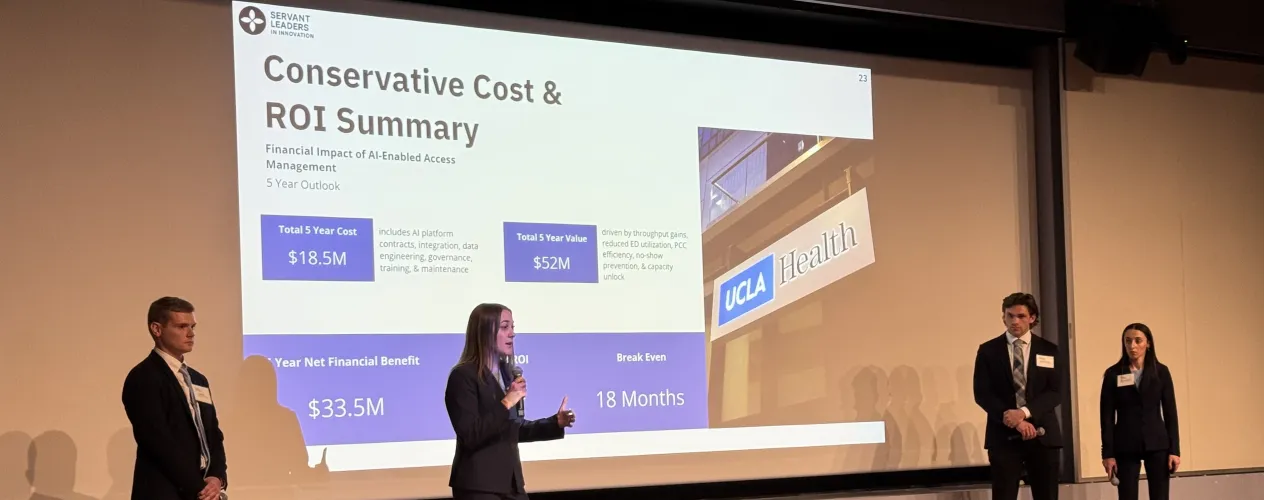
Teams from across the U.S. competed in the 7th annual “Healthcare Management Case Competition” at the UCLA Fielding School of Public Health, which brought healthcare management graduate students together to solve a real-world challenge faced by UCLA Health.
The Jan. 30 event was the final competition of this year’s series, which began late in November, 2025 with 92 teams from 36 universities across the country. The prompt asked each team to develop and present a five-year plan, complete with costs and savings estimates, to integrate the use of artificial intelligence (A.I.) into the UCLA Health system.
“Their strategy was required to include key goals and a prioritization of those goals; areas where A.I. could provide the most value; and an implementation plan that came with some cost estimates,” said Dr. Laura Erskine, professor in the UCLA Fielding School’s Department of Health Policy and Management and director of UCLA Fielding's Center for Healthcare Management. “The student teams are challenged to provide solutions and recommendations to a real-time, real-world management task, and it is a great, `hands-on’ learning exercise for the participants.”
UCLA Health, the main sponsor of the competition for all seven years, serves more than 880,000 patients annually, at five hospitals and through 290 clinics across southern and central California. The healthcare system is affiliated with the university, primarily through the David Geffen School of Medicine at UCLA, the university’s accredited medical school. Along with sponsoring the event, the healthcare system provides the judges for the competition, a mix of medical and management staff.
“We’re presenting a forward-looking strategy for how UCLA Health can best utilize artificial intelligence, and where it’s needed most, and where it’s needed most is patient access,” said Collin Mclnelly, a student in the Master of Health Services Administration program at Xavier University in Cincinnati, who led off his team’s presentation in the “final four” session of the event. “Our goal today is to show how AI tools can be implemented responsibility and with intention, to improve things like throughput, quality and safety, and long-term sustainability for UCLA Health and its mission – this strategy is not designed to automate the human aspect of care, but rather, through this strategy, it’s going to employer UCLA Health’s physicians and workforce to be more empowered when delivering care.”
Along with sponsoring the event, the healthcare system provides the judges for the competition, a mix of medical and management staff. Through a series of presentations, question and answer sessions, and discussions amongst themselves, the judges came to a ranking of the finalists that led to the final awards:
- 1st Place ($12,000): Servant Leaders in Innovation - Xavier University (Cincinnati, Ohio): Chloe Hamm, Olivia Brockman, Jack Dee, and Collin Mclnelly
- 2nd ($8,000): SEEA Consulting LLC - University of Minnesota (Minneapolis, Minnesota); Saisindhu Marella, Anthony Ogliore, Estefania DeJesus, and Emma Streun
- 3rd ($4,000): MEM Consulting - Johns Hopkins University (Baltimore, Maryland): Morgan Moore, Elizabeth Hamilton, and Misha Caternor
- 4th ($2,000): Dream Team – California State University, Long Beach (Long Beach, California): Elizabeth Kavianian, Ruchi Narkar, David Martinez, and Mia Cabrera
Further information about the program is available on the Center's website; along with the case competition, the Center also hosts the Paul Torrens Health Forum at UCLA, an established community gathering where practitioners and academics regularly discuss timely public health issues affecting the industry.
“As healthcare continues to become increasingly complex, artificial intelligence is emerging as a transformative tool; AI promises to impact operations by improving efficiency, reducing medical errors, and enhancing the patient and clinician experience - yet it also introduces new risks,” Erskine said. “Through the case competition, our students, and the students from other programs who enter, have a chance to grapple with the potential realities of that transformation.”