UCLA Fielding and UCLA School of Dentistry collaborate in nationally-recognized pediatric dentistry program
UCLA Fielding graduate student Dr. Damaris Arriola Zarate is pursuing a MPH alongside her dental clinical training at UCLA's School of Dentistry.
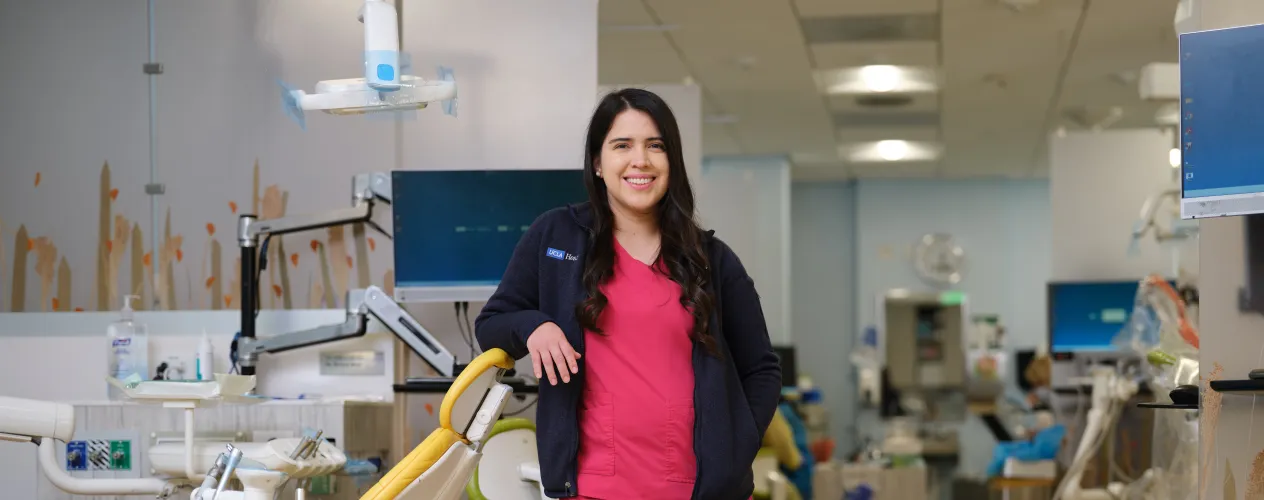
UCLA Fielding graduate student Dr. Damaris Arriola Zarate is pursuing a Master of Public Health alongside her dental clinical training at UCLA's School of Dentistry in an integrated medical/dental approach that has repeatedly earned national recognition.
"If we want to change children’s oral health outcomes, we have to train dentists differently,” said Arriola Zarate, (UCLA SOD D.D.S. ’22, P.D. ’27), who is a student in UCLA Fielding's MPH for Health Professionals program in the Department of Community Health Sciences, alongside her clinical training at UCLA. “They’re completely connected.”
At the UCLA School of Dentistry (SOD), that belief shapes how clinicians are trained, how communities are served, and how leadership is cultivated.
One program allows dentists to complete their pediatric dentistry certificate while earning an MPH through UCLA’s Fielding School of Public Health. The dual perspective changes how residents think about care from the beginning, participants said.
"Every day I see how many factors influence a child’s health beyond the clinic,” Arriola Zarate aid. “The neighborhood they grow up in, their school, family support ... all of those things affect their oral health.”
Before returning to UCLA SOD for residency, Arriola Zarate worked as a general dentist in a community clinic serving largely low-income families. The experience reinforced how closely oral health is tied to everyday realities.
“When a parent is struggling with housing or employment, oral health may not be their top priority,” she said. “Understanding that helps you meet families where they are.”
That philosophy is at the heart of the training model developed by Dr. Francisco Ramos-Gomez, who holds a D.D.S., MS, and MPH, and serves as professor and chair of the School of Dentistry's Section of Pediatric Dentistry. His approach integrates clinical excellence with prevention, public health strategy, and deep community partnership.
“When you open a child’s mouth, you can see that their teeth are a window to the environment and the world they are living in,” Ramos-Gomez said. “You have to understand the child, the family, and the community to treat the disease. Otherwise, you’re only treating a tooth.”
Ramos-Gomez believes the future of the field depends on this integrated medical/dental approach.
“I don’t see pediatric dentistry without public health,” he said.
UCLA’s model has earned sustained national recognition, with a fourth consecutive award from the Health Resources and Services Administration strengthening the initiative. Each successive funding cycle earns a new acronym; for 2025 to 2030, it’s known as BRIGHT-PD (Building Resilient, Innovative Growth, Health, and Training in Pediatric Dentistry).
The current grant cycle expands tele-dentistry services, integrates community health workers into care teams, advances dual clinical–public health training, strengthens care for children with autism and other neuro-developmental conditions, and deepens partnerships with community clinics, including the Wilson-Jennings-Bloomfield UCLA Venice Dental Center.
Through tele-dentistry, families who live far from clinics or face transportation and work barriers can consult with providers remotely. Community health workers help bridge cultural and language gaps while guiding parents through prevention strategies and care navigation.
For residents, the program’s impact often becomes most visible through patient relationships.
Arriola Zarate recalled treating a young patient whose mother had immigrated from El Salvador, the country where she herself was born.
“She told me she never thought she would find someone from her country to treat her child,” Arriola Zarate said. “It makes families feel welcomed and understood. And when that relationship is there, they want to come back, and we can work together to improve a child’s health.”
Her MPH curriculum builds on this foundation. As a pediatric dentist trained in epidemiology, health policy, and community-based program design, she will be equipped to address upstream factors shaping children’s health and advocate for prevention-focused systems beyond the clinic.
Graduates leave prepared not only to treat children but to expand access, influence policy, and advance prevention-focused models nationwide. The program’s scale and rigor attract applicants from across the country, with more than 225 applicants each year competing for just seven positions.
For Ramos-Gomez, that broader mission defines the program’s purpose.
“We are not just training clinicians," he said. "We are training socially accountable pediatric dental leaders.”