UCLA Fielding welcomes new students to the academic year
The UCLA Fielding School of Public Health is welcoming nearly 500 new undergraduate and graduate students this fall.
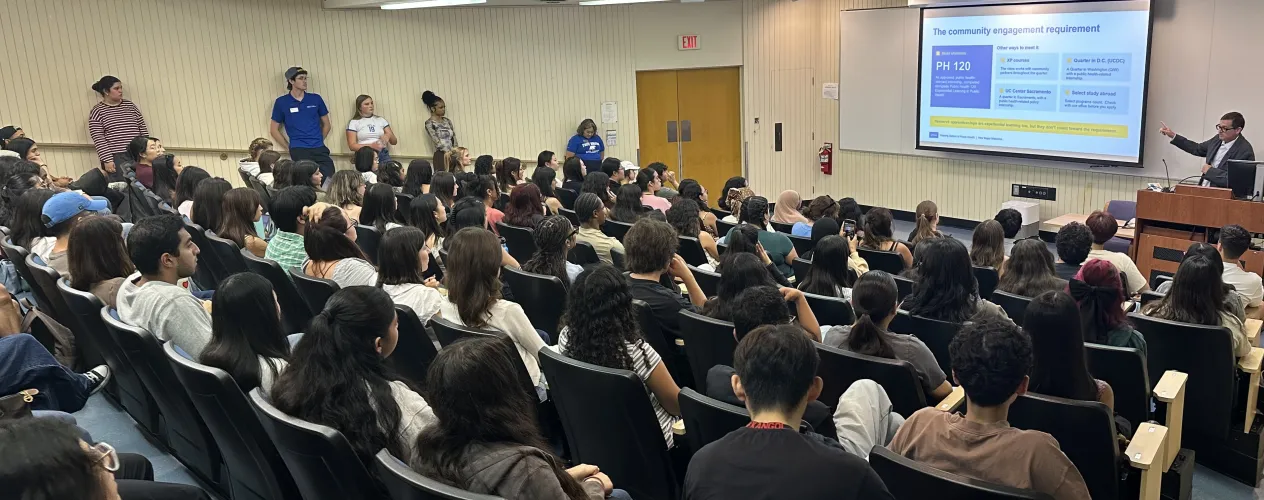
The UCLA Fielding School of Public Health (UCLA Fielding) welcomed nearly 500 new undergraduate and graduate students this fall, one of the largest groups of new students in the school’s more than six-decade-long history.
“We are the ‘number one’ public university in the country,” said UCLA Fielding’s Dean Kari Nadeau, who joined the school as dean in July, referring to national college rankings published this week. “UCLA is large, yet it still has a family ethos. I want to make sure that each of you, as you go through this year — there are going to be ebbs and flows, ups and downs —know that we at UCLA Fielding are here for you.”
More than 250 attendees participated in a series of on-campus events during new student orientation the week of Sept. 21-25, the beginning of the academic year at UCLA. The attendees included some of 165 newly admitted undergraduates in the BA and BS programs and 327 graduate students in the school’s masters’ and doctoral programs at UCLA Fielding.
“Public health is a practice-based field, it’s one where you often are asked to work with the community, so having an experience out in the community is an important part of the educational program,” said Dr. Kyle McJunkin, UCLA Fielding’s assistant dean for academic programs, who outlined the opportunities for field work and internships, both in the U.S. and internationally. “Finding this sort of placement sounds rather daunting, but we have some great resources in place to support our students in making it happen.”
In addition to the school-wide orientation sessions, UCLA Fielding’s five academic departments — Biostatistics, Community Health Sciences, Environmental Health Sciences, Epidemiology, and Health Policy and Management — hosted their welcome events for new students, as did UCLA Fielding’s central offices.
“The studies we design, the methods we develop, the data we analyze today will inform the decisions that protect people's health in the years ahead, and the students we train will carry this work forward,” Dr. Michele Guindani, chair of the Department of Biostatistics, told the new students in his department. “Each of us contributes to this goal, whether through research, teaching, study, or the administrative work that supports our programs.”
Allison Liang - a master of public health student in the Department of Environmental Health Sciences who serves as part of the school’s Student Ambassadors team, which supported multiple events during orientation week - called UCLA Fielding’s efforts to support students ‘above and beyond’.
“Even in the week before classes start, I’ve already engaged with so many peers, faculty and staff through the events planned for us,” Liang said. “By getting to know everyone, I feel more supported and confident in my graduate journey here at UCLA.”
As an alum who volunteered to work at the events as well, Monique Trinh (MPH, ’23), said there’s a clear lesson for new students at UCLA Fielding.
“The most important message I wanted students to take away is that being a Fielding School student is not simply an identity they inherit; it is one they will shape together through how they learn, use their influence, support one another, and place their individual strengths in service of a shared public health purpose,” said Trinh, who spoke at the graduate student orientation. “By doing so, they contribute to Fielding’s commitment to protecting tomorrow today.”
See highlights from our 2026 Graduate Student Orientation Day