UCLA Magazine | "The secret lives of UCLA professors: Dr. David Eisenman"
Don’t be surprised if you can’t book an early meeting with Dr. David Eisenman - he likes to leave his calendar open in case the swells are good.
In a feature published in the Fall, 2026 edition of UCLA Magazine, Dr. David Eisenman, professor in UCLA Fielding's Department of Community Health Sciences, was one of four UCLA Fielding faculty profiled under the headline: “Our faculty members excel in their professional fields. But sometimes what they do outside the classroom is even more revealing of who they are.”
On any given day, you’ll find UCLA professors lecturing on political science, designing healthier communities, studying wildlife, advancing public health or teaching the next generation of architects. But when the lecture ends or the lab closes, many of them head off to other pursuits — ones that are often every bit as fascinating as their professional work.
Some are hobbies, escapes that are wildly different from the professors’ day jobs in academia. Some other pursuits might be considered second careers. All are extensions of the same curiosity, creativity, and problem-solving that define these professors’ research and teaching. The skills they develop outside the classroom often shape the way they approach their scholarship; conversely, the questions they ask as scholars frequently spill over into their personal lives.
Consider this a peek behind the office door. These are the passions, projects and pursuits that don’t always appear in faculty biographies but can provide a fuller portrait of the people behind them.
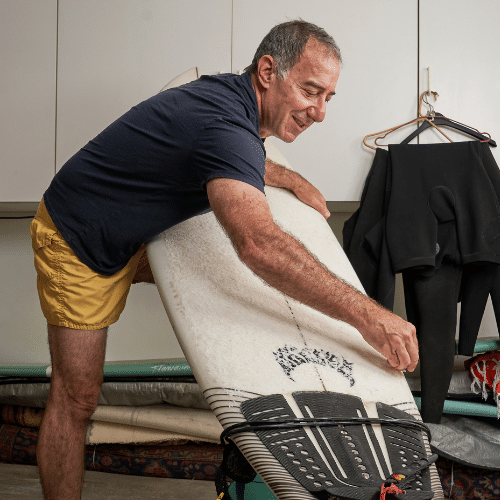
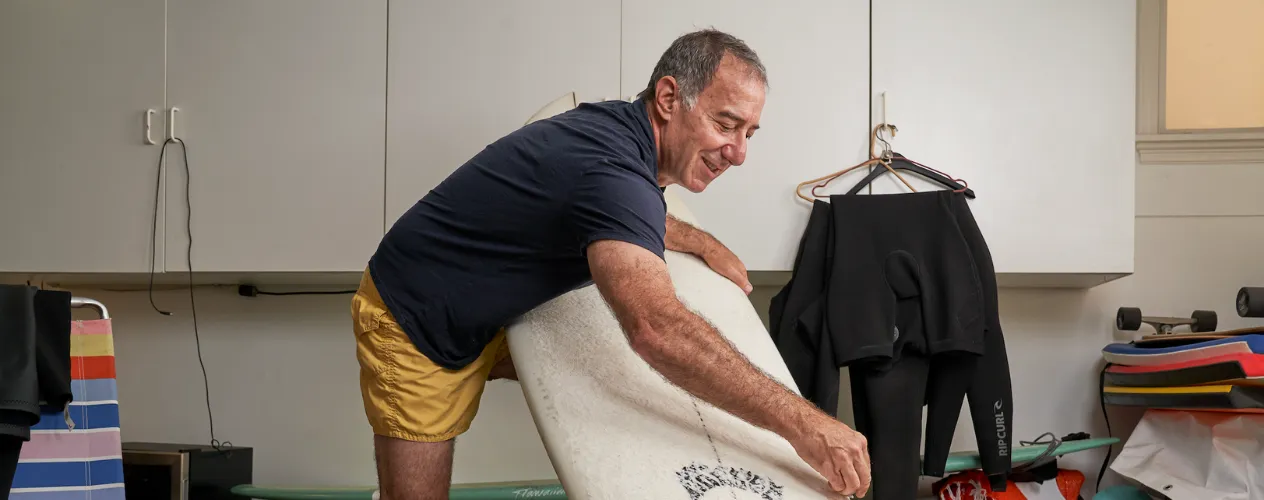
Don’t be surprised if you can’t book an early morning meeting with David Eisenman M.S. ‘02 — he likes to leave his calendar open in case the swells are good. If they are, he’ll grab his surfboard, open his garage door and walk the block and a half from his home to the ocean.
“Surfing has to be a secret life because the best surf windows happen during the day, often during working hours,” Eisenman admits. “But I’ve been in the business long enough that I’m willing to come clean here.”
Eisenman surfed on and off all his life — as a kid in Cape Cod, and in Far Rockaway, New York, in early adulthood. But he started surfing for real once he moved to California around age 30. “One of my first jobs at UCLA was an adjunct position at RAND, on the water in Santa Monica,” he recalls. “Watching people come to work and change into wet suits in the bathroom inspired me to rush out and get myself a board.”
Today, he surfs three times a week — even if the waves aren’t great. “I’ll put the board in, just to feel the swells of the ocean and stare at the horizon,” he says. “Just to be there for 30 minutes and then go to work makes me feel immune to frustration or irritation all day long.”
Eisenman is also an avid hiker — he’s backpacked everywhere from Nepal to the Alps — but much as he loves it, he says it doesn’t have the “magnetic quality” of surfing. “Sometimes I think if I had grown up in California I might not have become a doctor,” he says. “Surfing might have been too enticing and kept me away from the books.”