UCLA researchers and local partners host clean soil event at Watts community garden
The team, including students, staff, and faculty from the UCLA Fielding School of Public Health, screened 100 soil samples.
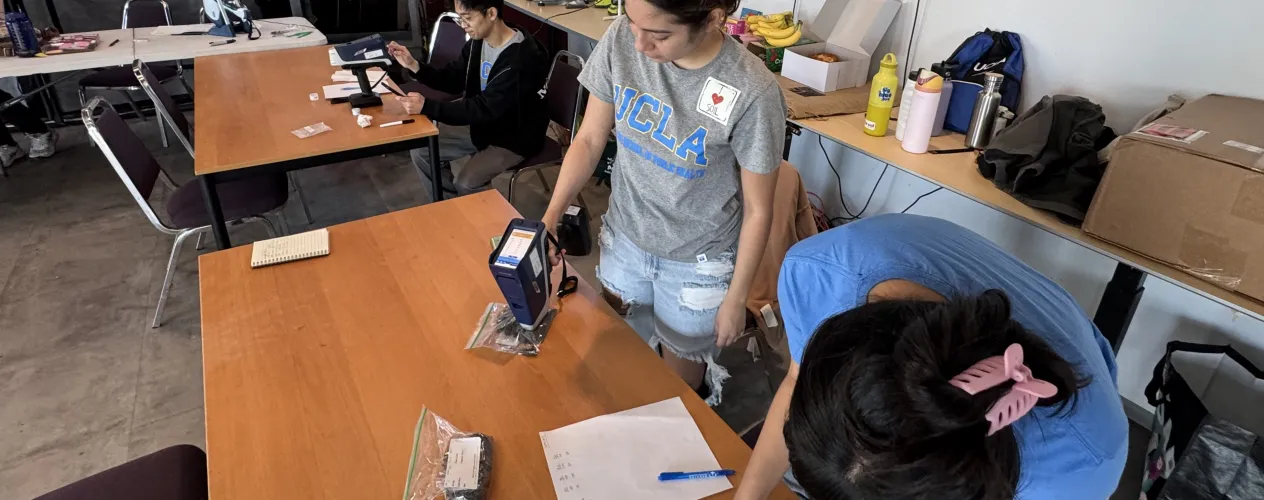
A team of UCLA researchers has joined with community partners to test soil samples from neighborhoods across Los Angeles County for contaminants, including lead and other heavy metals.
“Soil screening is a necessary first step, but it’s not a solution,” said Dr. Kirsten Schwarz, associate professor in the UCLA Fielding School’s Department of Environmental Health Sciences and a leader of the LA Urban Soil Social Impact Collaborative, a community-university partnership funded by UCLA’s Center for Community Engagement. “Whether folks are concerned about soil quality because they are growing fruits and vegetables at home or they’re concerned about exposure from their kids playing in the yard, residents of all these communities are eager for knowledge and actionable solutions. Soil amendments, like compost and clean soil, are low-cost and accessible options that can help manage the risks.”
On March 7, the team provided testing and counsel at MudTown Farms in the Watts neighborhood in Los Angeles, including screening samples for legacy contamination from nearby industrial land use. The testing was co-sponsored by the Watts Labor Community Action Committee (WLCAC), which manages the farm and community gardening program.
“We’d like to know if it is safe for us to consume what we produce in our garden,” said Hector Garcia, a retiree from nearby Huntington Park who attended the event with his wife Luisa. “We retired like two years ago, but we grow everything – oranges, guava, limes, lemons – we have all kinds of trees.”
The Watts event was the fourth in a series of similar field days across the county; the previous three were held in communities hit hard by the 2025 Los Angeles County wildfires. The January blazes, in both the Pacific Palisades-Malibu area adjacent to the Santa Monica Mountains, and the Altadena-Pasadena communities in the foothills of the San Gabriel Mountains (Eaton Canyon), claimed at least 31 lives and damaged or destroyed more than 18,000 structures, according to Los Angeles County officials.
“After the Eaton Fire, so many residents were left wondering what was in their soil - what they were walking on, planting in, and breathing around their homes,” said Kristy Brauch, a master gardener from Pasadena who works with the project. ”There’s a real mix of fear and urgency, but also an incredible desire to understand and take action.”
So far, the team has tested almost 700 samples for roughly 300 residents across the County, including events in Pasadena in October and December.
“It was great that they are doing this - having information is crucial," said Kevin Bolling, who lost his Altadena home in the fires and brought samples to a Dec. 6 event in Pasadena. "This is probably the third time I've submitted samples, and because it was one-stop and here, we got them right away - but two other samples, I received no test results back, so I have no idea ... my results are not great, but at least I know and knowing is the biggest part."
The Collaborative, which includes researchers from across UCLA and LA-based organizations, including the non-profit TreePeople, will host additional pop-up soil testing events, workshops, and remediation projects across the region, organizers said.
The team screens soil samples using portable X-ray fluorescence analyzers to detect heavy metals, including lead, a known cause of significant illness. Participants can have as many as three soil samples screened at the events, and received personalized consultations on how to improve soil health and safety in their yards and gardens.
“These testing events meet people where they are, transforming worry into knowledge,” Brauch said. “The response has been overwhelmingly positive; my neighbors are already asking when the next one will be.”
The Collaborative, co-led by Schwarz, who also teaches at the UCLA Luskin School of Public Affairs, and Dr. Jennifer Jay, professor in the UCLA Samueli Department of Civil and Environmental Engineering, aims to leverage university research and resources and apply local and Indigenous knowledge to advance equitable access to healthy soils. It includes community-based, tribal, private and academic partners from across Los Angeles.
“Addressing soil pollution in Los Angeles and beyond requires community-engaged approaches that center local knowledge and priorities,” said Monika Shankar, a doctoral candidate in the UCLA Fielding School’s Department of Environmental Health Science and a principal investigator on the project. “Our collaborative serves as a proof of concept that meaningful and impactful research emerges when communities are partners throughout the entire process."
Funding
This project has been made possible with support from UCLA’s Center for Community Engagement and community partners that include the Centre for Applied Ecological Remediation, Communities for a Better Environment, Laboratory for Indigenous Knowledge Systems, Physicians for Social Responsibility-LA, TreePeople, and the WLCAC. To learn more about The Collaborative, visit https://www.la-soil.org/.