Color Class
yellow
THE U.S. SPENDS MORE THAN $10,000 PER PERSON on health care per year, approximately twice as much as the average spent by comparable high-income countries. There is ample evidence we aren’t getting our money’s worth. The rate of amenable mortality — premature deaths that could have been avoided with effective and timely health care — is higher in the U.S. than in any comparable high-income country, and more than 50 percent higher than in France, Australia, Japan and Sweden.
AFTER A $1 MILLION GIFT from Tom and Edna Gordon and the Don S. Levin Trust established the Paul Torrens Chair in Healthcare Management at the UCLA Fielding School of Public Health, Tom Gordon vowed that he was just getting started. Determined to find others to join him in honoring Dr.
SCROLLING THROUGH INSTAGRAM IN AUGUST 2020, DR. KRISTEN CHOI (MS ’18), assistant professor in the UCLA Fielding School of Public Health and the UCLA School of Nursing, came across an ad that would dramatically alter how she’d spend her days.
FSPH at American Public Health Association Annual Meeting and Expo
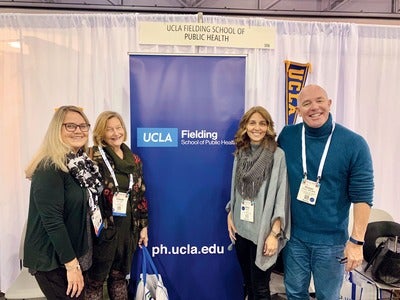 THE 2019 AMERICAN PUBLIC HEALTH ASSOCIATION (APHA) annual meeting in Philadelphia was attended by Fielding School faculty, students, staff, and alumni, many of whom had their work featured. The meeting’s theme was “Creating the Healthiest Nation: For science. For action. For health.”
WHAT WAS LEARNED
Print-media coverage of U.S. gun control policy in the wake of mass shooting events has resulted in increases in firearm acquisition, particularly in the states with the least restrictive gun laws.
Sebastian Ramirez, MPH Student
THE 175 INDIVIDUALS IN ATTENDANCE at the Health Forum at UCLA FSPH in March 2016 included some of the most powerful health care professionals in the region.
AMID A RAPIDLY CHANGING LANDSCAPE, the only certainty for health care management professionals is that the future is fraught with uncertainty.
JACK NEEDLEMAN was reading The Boston Globe one morning in 1998 when he came across an article that would alter the course of his career.
THE PERCENTAGE OF PEOPLE IN THE UNITED STATES without health insurance rose from 7.9 in 2017 to 8.5 in 2018 — the first year-to-year increase since 2009, just before the Patient Protection and Affordable Care Act (ACA) became law. But at a time when the ACA has been weakened federally, California has bucked the national trend.