The Atlantic | "The dangers that scientists found inside L.A.’s smoky homes"
UCLA Fielding's Dr. David Eisenman and Dr. Yifang Zhu were interviewed by The Atlantic about research into the health impacts of the 2025 wildfires.
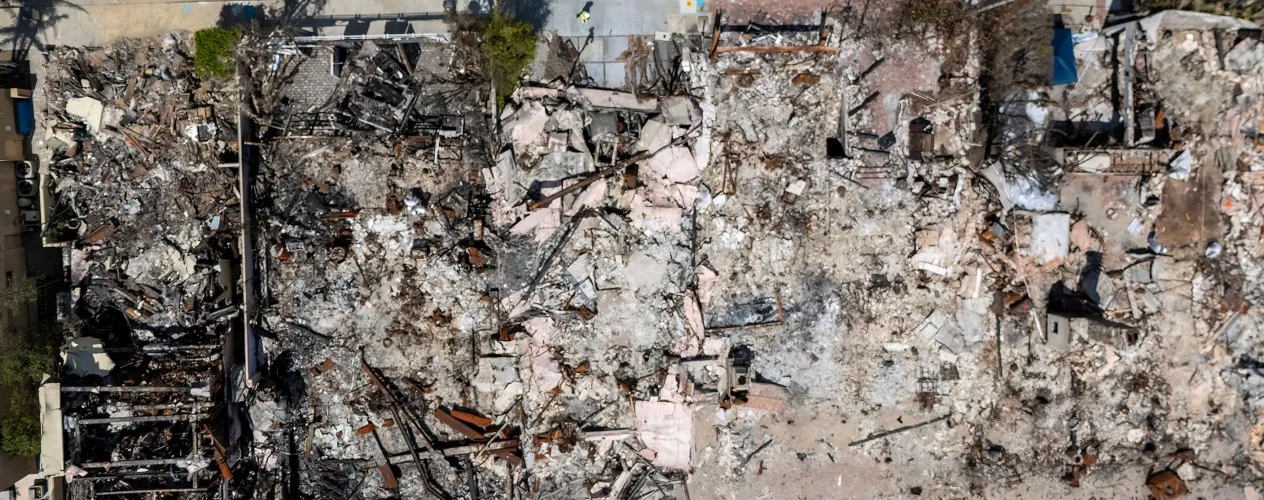
Dr. David Eisenman, with the Department of Community Health Sciences, and Dr. Yifang Zhu, with the Department of Environmental Health Sciences, were interviewed by The Atlantic about their research into the health impacts of the 2025 Los Angeles County wildfires.
" ‘It’s a new type of fire, because it’s an urban conflagration,’ David Eisenman, a researcher at UCLA who has spent the past 25 years studying the impact of disasters on mental and physical health, told me.
These fires may start in areas where wildland and urban settlements edge up against one another, but as they spread, they ‘mostly consume, by volume, man‑made products in megacities—that’s a real difference.’
Researchers have long studied what goes into the air when trees burn in a fire, but when the fuel is homes, cars, and businesses—the stuff of people’s lives—what ends up in the air is largely unknown. The many chemicals, including asbestos and lead, in our homes can form a toxic soup. The combustion process can also create new hazards; scientists were surprised to find airborne nanoparticles of hexavalent chromium, the contaminant made famous by the movie Erin Brockovich, hanging around cleanup sites.
One surprise lesson was that the fire risk didn’t end once the smoke had dissipated. Levels of benzene spiked, then came down after about a week. But even after the outdoor air began to clear, measures of hazardous chemicals in indoor air showed signals from fire-related compounds that had infiltrated people’s homes and kept off‑gassing. While people were looking to the smoke and fire as the danger, scientists were seeing real risk lurking inside homes, as people hunkered down.
‘The outdoor air became cleaner, but the indoor levels went up,’ Zhu said.”