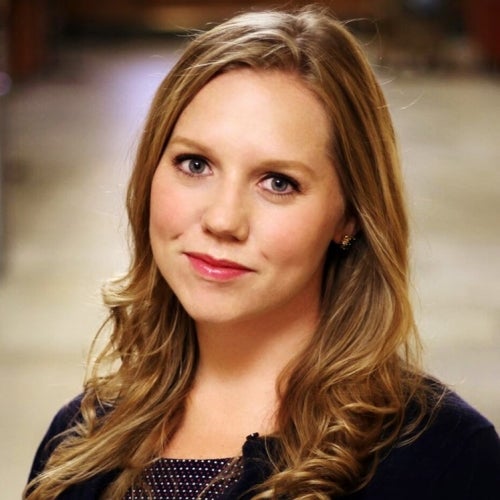
Nurse and UCLA Fielding graduate student Christina Kenoski on her research into the use of artificial intelligence for charting
Christina Kenoski, RN, has been recognized for researching the use of artificial intelligence for charting as her capstone project at UCLA Fielding.

Christina Kenoski, RN, has been recognized for research the use of artificial intelligence (A.I.) for charting as her capstone project at the UCLA Fielding School of Public Health. Kenoski completed her studies in the Master of Healthcare Administration (MHA) program at the end of the Fall (2025) Quarter. The MHA program is led by Dr. Laura Erskine, professor in the Department of Health Policy and Management, and is administered by the Office of the Executive Programs in HPM.
Kenoski spoke with UCLA Fielding's Gigi Hooghkirk about her background and experience in the MHA program, including her capstone project.
Q: Without revealing anything confidential, can you give us an overview of your capstone project?
Kenoski: My capstone examined how hospitals can reduce the burden of manual chart abstraction within quality departments by exploring the role of AI-assisted abstraction. Quality departments rely on clinical registries, structured databases that capture standardized patient and outcome data, to support quality improvement, regulatory reporting, benchmarking, and participation in national performance programs. Populating these registries requires data abstraction, a labor-intensive process in which staff manually review electronic health records to extract key clinical variables that are often not available in discrete fields. While this work is essential to monitoring outcomes and improving care delivery, it places significant strain on quality teams. My project evaluated current abstraction workflows and staffing constraints and compared future-state models, including AI-enabled abstraction with human validation and alternative outsourcing approaches, to assess operational feasibility, governance considerations, and the financial impact of each option while maintaining data integrity and patient safety.
Q: What is a key takeaway you have about the experience?
Kenoski: One of my biggest takeaways was realizing how important it is to match innovation with day-to-day operations. Even promising tools like AI only make a real difference when they’re implemented with clear governance, strong data oversight, and an understanding of how work actually gets done on the ground. The experience reinforced that meaningful change depends on balancing efficiency with accountability, clinical judgment, and thoughtful change management.
Q: Any advice for MHA students who will be working on their capstone?
Kenoski: Start thinking about and planning your MHA Capstone as soon as possible. Spend time upfront clearly defining the problem, learning how the organization actually operates, and building relationships with key stakeholders early on. Your project might evolve like mine did, so staying flexible is important, but keeping your recommendations practical and data-driven will help ensure your work has value beyond your final Capstone report.
Q: Anything else you’d like to share?
Kenoski: The capstone was one of the most impactful components of my MHA experience. It allowed me to apply concepts from finance, operations, information technology, and leadership to a complex healthcare challenge. It also strengthened my ability to translate analysis into insights that resonate with healthcare leaders and will continue to inform my work in healthcare quality and leadership.