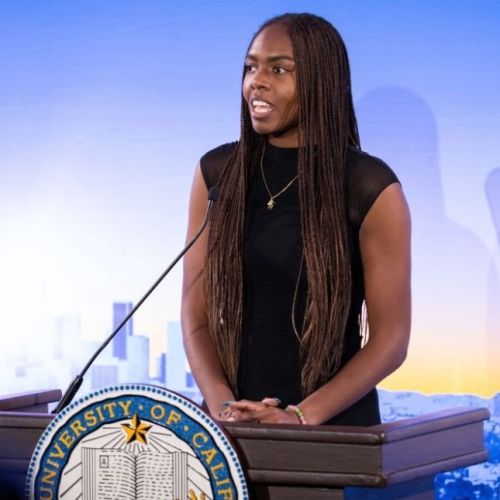
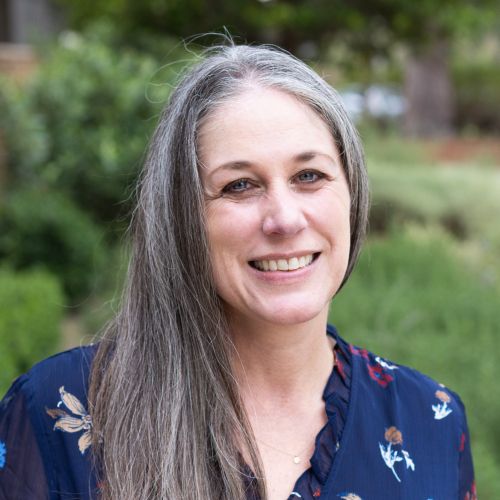
UCLA Fielding alum Naomi Hammonds (MPH ’26) serves university as member of “True Bruin Values” committee
UCLA’s refreshed values - integrity, excellence, and belonging - came after two years of conversation, collaboration, and feedback across campus.

What does it mean to be a Bruin?
For 20 years, UCLA has had a five-word answer: integrity, excellence, accountability, respect and service.
That answer has now gotten a refresh.
UCLA’s newly updated True Bruin Values are integrity, excellence, and belonging, three guiding principles that will serve as a shared framework for students, faculty and staff across the university.
Getting to those three words — and their accompanying principles and actions — took more than two years and involved input from over 2,500 Bruins, who weighed in through online surveys, focus groups and community conversations. Along the way, proposed new values changed, changed again and ultimately landed somewhere the steering committee behind the refresh effort did not initially expect.
That was the point.
“We wanted UCLA’s values to be shaped by the people who would be asked to live them,” said Emily Rose, assistant provost and chief of staff to UCLA’s executive vice chancellor and provost, who helped lead the refresh.
Thousands of voices: Building True Bruin Values from the ground up
UCLA’s previous values dated back to 2005, when the University of California announced its four “ethical values”: integrity, excellence, accountability and respect. UCLA quickly adopted them for its own campus community, first introducing the principles to incoming students as a framework for the standards expected of Bruins.
A short time later, presentations at summer orientation focused on what it meant to be a Bruin, and the phrase “True Bruin” was developed with student input. Then-Chancellor Gene Block added “service” to the list in 2009 to reflect UCLA’s role as a public university, bringing the overall number of values to five.
Over the years, those values found their way into welcome events, workshops and other programs across campus. Even so, awareness varied widely: Some knew and consciously put the values into practice, while others had little or no awareness of them.
“For too many Bruins, they were words encountered once — or not known at all — rather than a common standard for how UCLA makes decisions, how we work together and how we treat one another,” Rose said.
Naomi Hammonds was one of the students who did absorb them early.
Hammonds, who joined the refresh steering committee two years ago while serving as undergraduate student body president, and who continued with the group as graduate student body president, remembers researching UCLA’s values before she even applied to the university. Once on campus, she encountered them again through orientation and Residential Life.
Still, she said, familiarity with the values wasn’t the same as seeing how they translated into daily life.
“We wanted it to be more than just words on a website,” said Hammonds, a UCLA Fielding alum (MPH ’26, Community Health Sciences) who is currently in the MBA program at the UCLA Anderson School of Management this fall. “We wanted to show how we live the values. How do we breathe these values?”
That question helped drive the refresh, which launched in 2024 with its 27-member committee of students, faculty and staff from across campus.
Executive Vice Chancellor and Provost Darnell Hunt said the university wanted to reconsider the values through a more inclusive process that reflected UCLA as it exists today.
“We brought in literally hundreds of voices across a range of different community members — stakeholder groups, students, faculty, alumni, staff — to really think about what it means to be a Bruin and the type of community we want to have,” he said.
‘Back to the drawing board’
The committee began by surveying the UCLA community about the values that resonated most with Bruins. Responses were analyzed and tested with different groups across campus, including through quarterly Campus Community Conversations events that were open to the entire Bruin community.
At these gatherings, participants came together around small tables to talk through the newly proposed values and what they might look like in practice.
Maia Ferdman, staff director for UCLA’s Dialogue Across Difference initiative and a steering committee member, helped design the conversations. Attendees were intentionally seated with people from different parts of UCLA, with a facilitator and note-taker at each table.
They were asked what the values meant to them, as well as when they saw those values practiced at UCLA and when they didn’t. Other UCLA groups and units used a specially prepared facilitation guide to hold their own smaller conversations on the values and submit the responses they had heard.
Putting the proposed values to the test
For Ferdman, the conversations showed how a single value could take on different meanings across a university as large as UCLA.
The proposed value of “belonging,” for instance, could look like a first-year student finding a sense of community in a residence hall, a faculty member receiving support from a colleague during the tenure process or a staff member whose team rallied around them during a tough time.
“There are so many stories that come out of this process that you start to see the universe of UCLA and all the ways these values can be lived and practiced,” Ferdman said.
The conversations also gave Bruins plenty of opportunity to say when something wasn’t working.
“There were definitely times in those community conversations where folks were saying, ‘Oh, this one doesn’t resonate,’” Hammonds recalled. “And then, ‘OK, let’s have that conversation, and let’s go back to the drawing board.’”
How five values became three
By fall 2025, the process had produced five draft refreshed values — “integrity and accountability,” “service with purpose,” “belonging through action,” “curiosity and growth” and “collaboration with humility.”
But further feedback from the community — through online surveys and campus conversations — suggested the framework was too broad and difficult to remember, Rose recalled. Members of UCLA’s Academic Senate also questioned the absence of “excellence” and called for stronger connections to the university’s teaching and research mission, along with suggestions about truth and individual accountability.
Rose described what followed not as a single dramatic turning point but as a “chorus.” The steering committee restored “excellence”; made references to teaching, research and service more explicit; and strengthened the language around evidence, truth and personal responsibility. It also condensed the overall framework from five values to three: integrity, excellence and belonging.
For Ferdman, the return of “excellence” was a clear example of community feedback shaping the refresh outcome.
“This is distinctly UCLA,” she recalled hearing, especially from faculty, in the community conversations.
Hammonds heard it too.
“We want excellence for our research. We want excellence for our students,” she said. “We want excellence across the board in our sports.”
Committee members stressed that the other ideas weren’t lost in reducing the list from five to three. Accountability and humility, for instance, are reflected in “integrity.” Curiosity, service and collaboration appear under “excellence.” Respect, inclusion and building bridges across differences are folded into “belonging.”
“The final structure is simpler to remember without being thinner in substance,” Rose said.
The true test: Putting words into action
The next challenge is making UCLA’s three True Bruin Values matter beyond their rollout. Together, they offer a detailed framework for how Bruins can put them into practice — and live them on a daily basis.
“Integrity” means communicating honestly and transparently, basing decisions on evidence and truth, and taking responsibility for one’s actions. “Excellence” means holding oneself to high standards in teaching, research and service while remaining curious, collaborative and committed to the public good. “Belonging” means creating inclusive environments rooted in mutual respect and finding ways to communicate across differences.
For Hammonds, the emphasis on action was one of the most important things to emerge from the process. As a teaching assistant and researcher, she can now recognize ways the values already show up in her daily life at UCLA.
“I hope students — I hope everybody — sees themselves in these values and how they engage throughout UCLA,” she said.
The refreshed values will be incorporated into student onboarding throughout True Bruin Welcome week and far beyond and into employee programs, with further efforts aimed at recognizing and sharing examples of Bruins putting them into practice.
“The real test is not whether people can recite the words ‘integrity, excellence and belonging,’” Rose said. “It is whether those values begin to influence classrooms, laboratories, meetings, hiring, recognition, leadership decisions and the way UCLA repairs trust when it falls short.”
Hunt hopes Bruins eventually can do both.
“For me, this process will be successful when you can stop anybody on campus and say, ‘What are the True Bruin Values?’ and they can recite them,” he said. “And more importantly, talk about the ways in which they can live them.”