UCLA’s Felicia Knaul brings global health expertise to UCLA’s International Education Week
Access to palliative care and pain relief varies greatly globally; these “completely unfair” realities must be addressed during healthcare training.
As a teenager in Toronto in 1984, Felicia Knaul spent the night of her high school prom in a hospital room, watching her father die from cancer.
“He had stomach cancer, he had surgery, and there was no way he would survive; the last days came and I asked him if he was in pain, and my father squeezed my hand repeatedly, so I went to see his physicians and asked for more pain medication, and he was denied the pain medication,” Knaul said. “They denied the pain medication because they said it could hasten his death – his death was imminent, but at the time, the standard was not to allow this.”
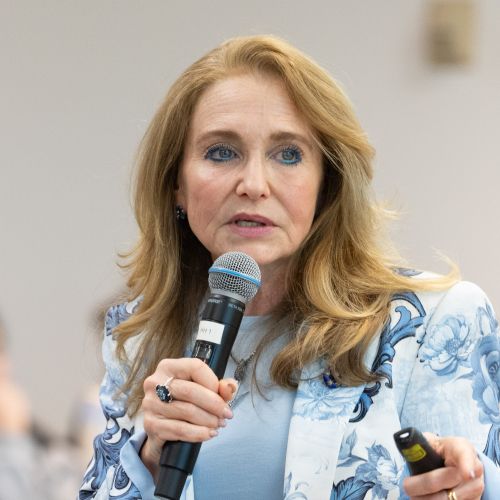
Today, 42 years later, that high school senior is now Dr. Felicia Knaul, an internationally known health economist who serves as a professor at UCLA’s schools of medicine, nursing, public health, and public policy. She has worked on global health issues across the Americas, is an elected member of the Mexican National Academy of Medicine, a fellow of both the Canadian Academy of Health Sciences and the American Academy of Nursing and spoke Nov. 17 at the UCLA Fielding School of Public Health as part of the university’s “International Education Week” series of events.
“As somebody who works at the intersections of global health, we are thrilled she’s here with us now, as an internationally recognized leader in global health, health systems, and health economics,” said Dr. Anne Rimoin, UCLA Fielding’s associate dean for global health and director of UCLA Fielding’s Center for Global Health Security, which hosted Knaul’s address. “We are so grateful to have you here and to have your expertise brought to our university and our school.”
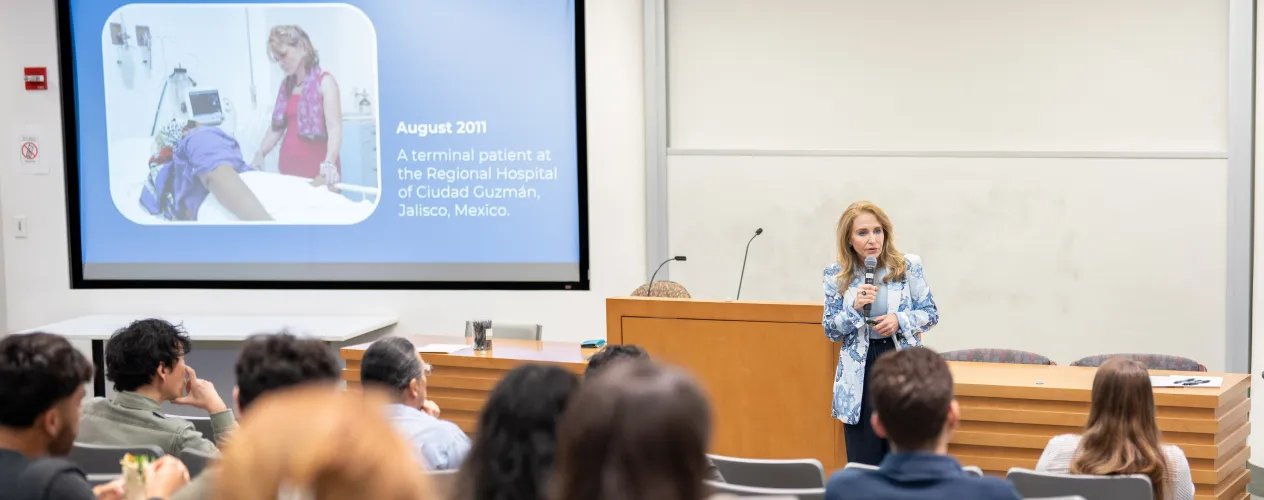
Knaul’s talk drew lessons from her career and the mission of UCLA’s new UCLA Prosper Institute UCLA Prosper Institute for Human, Social, and Economic Development, but she began her remarks with the very personal story of how her father’s death led to a life-long professional interest in palliative and hospice care that led to her leadership of The Lancet Commission on Global Access to Palliative Care and Pain Relief and the 2017 report “Alleviating the access abyss in palliative care and pain relief – an imperative of universal health coverage.”
“It helped me to understand the work that I did, going forward, to think about all the families that don’t have the medication, and what terrible choices they have to make, if they see their loved one dying in pain, to try and help them towards the end of their life,” Knaul said. “That is the reality in most of the world.”
The research team Knaul led found that in 2023, about 74 million people worldwide experienced serious health-related suffering annually, and that 80% of affected people live in low- and middle-income countries. These totals include more than 27 million people who died the same year, the equivalent of 45% of global deaths. The researchers also found that about half of the world’s population receives less than 1% of the oral and injectable morphine, critical for palliative care, that is distributed annually.
“This is completely unfair,” Knaul said. “And when I’ve done work with some students and residents, they say, ‘we are only trained not to give, we are never trained to give’ … they need to also be trained to give access to pain relief medication, as is appropriate; for example, you need to make it mandatory for medical, and all other health professionals, including divinity students, to be able to not only manage morphine, but also death.”
There is a path forward to achieve global access to pain relief and palliative care to alleviate suffering, Knaul said, and it depends on the education and training that institutions like UCLA can provide for students, policy makers, and the public.
“The sort of places we work, the sort of places that Annie and many of you work, (and) working with people at the end of life – you can sometimes lose hope yourself,” Knaul said. “What you have to carry with you that what we do is so important, what you do is so important, and what we can do together, at UCLA, is so incredibly important.”