Dr. Yifang Zhu presents 51st Lester Breslow Distinguished Lecture
"From Invisible to Visible: How air pollution research informs action in a changing climate" is the latest in the UCLA Fielding lecture series.
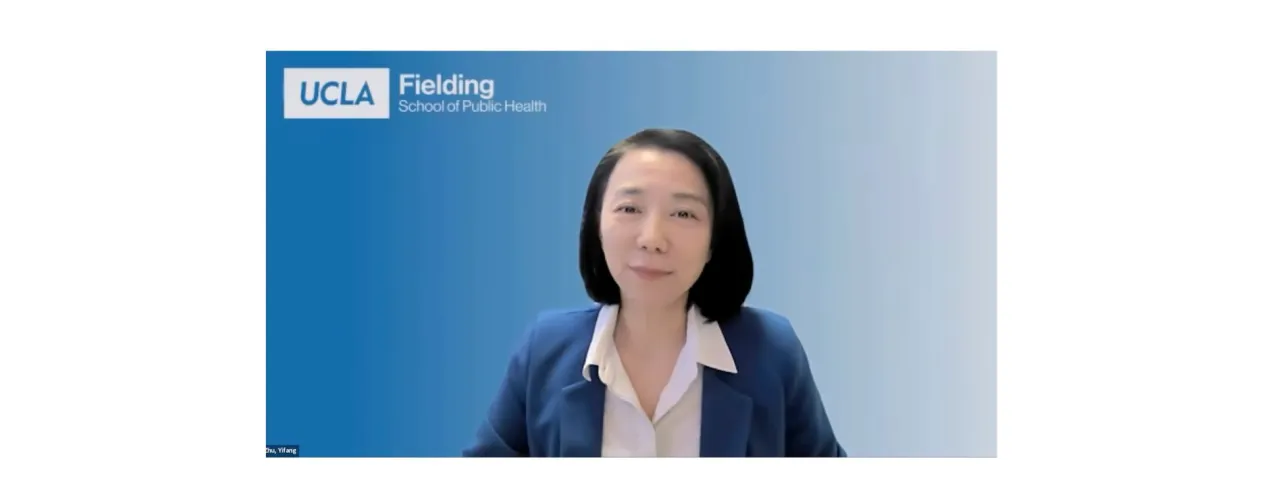
A quarter-century ago, when environmental engineer Yifang Zhu flew into Los Angeles to begin her doctoral studies at UCLA, she saw something new.
“Something I had never seen before - a thick, brownish layer suspended in the air,” said Zhu, who began at the Westwood campus in 1999. “Because I majored in environmental engineering, I had heard about L.A.’s smog, and knew it was bad, but in that moment, I did not understand why it was harmful – or what it meant for people’s lives.”
Zhu, who earned her PhD from UCLA in 2003, today serves as a professor in the UCLA Fielding School of Public Health’s Department of Environmental Health Sciences, and is an internationally known expert on the public health impacts of smoke, smog, and air pollution. Her research and leadership, which currently includes the most significant study of the impact of the 2025 Los Angeles County wildfires, led to her selection to deliver the 51st Lester Breslow Distinguished Lecture this week at the university.
“When I think of Yifang, her work ethic, her teaching, her research, her impact and the example that she sets, the words that come to mind are true excellence," said Dr. Ron Brookmeyer, dean of the UCLA Fielding School of Public Health and a distinguished professor of biostatistics.
Zhu’s Feb. 24 lecture, “From Invisible to Visible: How air pollution research informs action in a changing climate," focused on her research into the connections between air quality and public health, continuing through her education and research at UCLA.
“I certainly did not know that layer in the sky would become the foundation of my career; back then, I did not even know what public health was about,” Zhu said. “Time flies. Now, I am proud to call myself a public health scholar, and I have learned something simple but powerful from leaders in our field - especially Dr. Breslow - that public health begins with prevention, and prevention begins by identifying risk factors.”
Zhu’s research interests are primarily in the field of air pollution, climate change, environmental exposure assessment, and aerosol science and technology. Her current work focuses on measuring and modeling air pollutant emissions, transport, and transformation as well assessing and mitigating the associated health effects.
Zhu is also a faculty associate at the UCLA Center for Healthy Climate Solutions, and serves as a member of the research teams on the on-going Los Angeles Fire Human Exposure and Long-Term Health Study (L.A. Fire HEALTH Study); the Community Action Project (CAP) Los Angeles Air; and the Los Angeles County Department of Public Health-funded Aliso Canyon Disaster Health Research Study.
Her scholarship has been recognized by several national awards, including the Walter A. Rosenblith New Investigator Award from the Health Effects Institute in 2007, the Faculty Early Career Development (CAREER) Award from the National Science Foundation in 2009, and the Haagen-Smit Prize from Atmosphere Environment in 2011.
The Lester Breslow Distinguished Lecture was established in honor of Dr. Lester Breslow, former dean (1972-80) and professor emeritus at the UCLA Fielding School; he also served as president of the American Public Health Association and director of the California Public Health Department.
“Dr. Breslow's legacy continues today in public health and our school, including the importance of evidence-based research translating research into real world's solutions to save lives and mentoring tomorrow's public health leaders,” Brookmeyer said. “I'm so glad that Devra Breslow is here with us today; Devra, wife to Lester and partner in his career, remains dedicated to our school and to public health.”
Breslow was widely known for his early advocacy and research into health promotion and disease prevention. Breslow’s pioneering studies beginning in the early 1960s were among the first to show that simple health practices - getting regular exercise and sleep, not drinking excessively, not smoking, and maintaining a healthy weight - add both years and quality to life.
”Let me end where I began: when the smog clears in Los Angeles, you see L.A., and I am deeply grateful to do this work here - at UCLA, in a city that has shown change is possible,” Zhu said. “That change is because science made the invisible, visible, and because leaders like Dr. Breslow showed us that prevention is powerful. I truly believe, if we measure carefully, communicate effectively, and act collectively, we can clear more than smog in the future.”