UCLA Magazine | "Following the leaders"
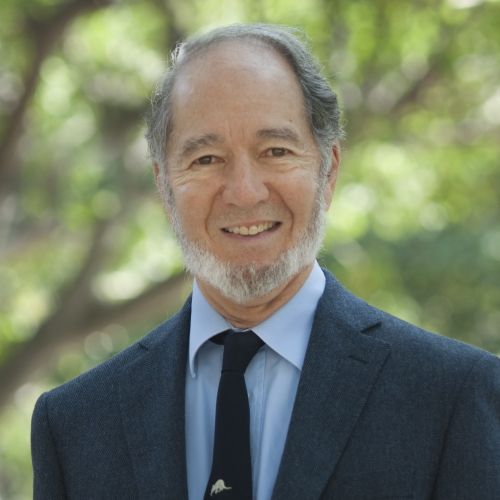
In his latest book, UCLA Fielding's Dr. Jared Diamond, professor in the Department of Environmental Health Sciences, offers an analysis of leadership.

In a Q&A published in the Fall, 2026 edition of UCLA Magazine, Dr. Jared Diamond, professor in UCLA Fielding's Department of Environmental Health Sciences and a Pulitzer Prize winner, offers an evidence-driven analysis of leaders throughout history. Who succeeds, who fails — and why?
Published in early September, Jared Diamond’s latest book, Prophets, Profits, Coaches and Kings: (When) Do Leaders Matter? (Mariner), is a sprawling, ambitious volume that puts an attribute sorely lacking in our age — leadership — under the microscope. Diamond, a polymath who retired as a distinguished professor of geography and physiology in 2024 after 58 years on the UCLA faculty, explores top bosses in politics, sports, religion and business, building on the research he mined in his previous bestsellers, such as The Third Chimpanzee, Guns, Germs and Steel, and The Uprising.
In an illuminating interview, he elaborates on just how important a role a good (or bad) leader can play in shaping an industry, an era, a culture.
Q: You open your book with an anecdote about Adolf Hitler. Why is he still so important historically?
A: He was important to the world as the most evil politician of the 20th century. He was important to me personally because I was born in Boston in 1937 to European immigrant parents. My wife’s parents emigrated from Poland in 1948; both of us have lived our lives under the shadow of Hitler. We keep asking ourselves: Would those members of our families who were killed in Europe still be alive if Hitler had died in a car crash that only injured him in 1930? Would the Holocaust have happened if Hitler had died?
The 19th-century historian Thomas Carlyle argued that “great men” shape history. Leo Tolstoy, author of War and Peace, claimed instead: No, great men are irrelevant; they are slaves of history. Who is right? I use modern data to address these questions.
Q: You suggest that the uniqueness of some leaders can be judged by what you call the “Hamlet test.” What is that?
A: A persistent question about any leader is: Could someone else have accomplished the same thing? If you are a citizen of a large country like the U.S., how on earth can you claim that the only person out of 340 million Americans who accomplished what FDR (Franklin Delano Roosevelt) or Bill Gates did was FDR or Bill Gates? Usually, that’s impossible. But sometimes there is only a small number of people who might conceivably have accomplished some major deed. That’s the Hamlet test.
I give the test that name because one can ask: Could anyone other than Shakespeare have written Hamlet, often considered the greatest play in the English language? Well, it’s not the case that any of the 4 million Elizabethan English people could have written Hamlet. [Shakespeare] had already produced masterpieces, and he wrote for Elizabethan England’s best theater company, with the best actors. We can be confident: If Shakespeare had died in childbirth, none of those other Elizabethan playwrights could have written Hamlet.
No one could claim that Jeff Bezos was the only one out of 340 million Americans who could have created an “everything store.” Other Americans did create everything stores, such as eBay and Walmart. But Jeff Bezos put his distinctive stamp on his everything store, Amazon.
Q. You portray many leaders as standing alone. Others, like Abraham Lincoln, who employed former rivals in his cabinet, were more collaborative. Then you show that the Christian and Mormon religions were each built by two individual protagonists: a charismatic founder (Jesus in the case of Christianity, Joseph Smith for the Church of Jesus Christ of Latter-day Saints). So, which is more successful, generally: standing alone or being collaborative?
A. That’s the wrong question: It’s the business school fallacy! Business schools justify the high tuition that they charge by claiming that they teach the one way to become a great leader. But the problem is that there are at least 37 ways of becoming a great leader.
Jesus and Joseph Smith were successful founding leaders because they were charismatic. But Stalin was a successful leader because he terrified people without being charismatic.
[John F.] Kennedy solved the Cuban Missile Crisis by repeatedly walking out of the meeting room of his advisors so as to let them think of decisive advice without being inhibited by the president. British Prime Minister Clement Attlee was much less charismatic than Winston Churchill, but he brought about the biggest changes of British society in the 20th century because he assembled a cabinet of talented ministers who shared his goals. Those are just five examples of the 37 different ways to be a great leader that business schools don’t teach you.
Q. How vital is a good education to becoming a great leader?
A. Often it helps. Prime ministers who go to college and concentrate in economics tend to boost their countries’ economies more than do prime ministers who drop out after high school. But there are also leaders who are effective despite having no formal education whatsoever. I worked for a decade as the environmental consultant for Papua New Guinea’s oil fields, then being explored by the international oil company Chevron. [The company] wanted to explore a remote small village from which no one had ever left to the coast or received any education.
Chevron sent its top Swiss and American lawyers to the village to negotiate a contract for oil exploration rights. The highly trained lawyers were sure that the negotiations with these “ignorant people” would be easy, that the lawyers would quickly get everything that they wanted and would be able to leave after two nights.
In the first afternoon of negotiations, the local people’s negotiators agreed with Chevron’s proposals and told them to come back the next day to sign an agreement. This seemed to be going easily. But on the next day, a different group of local people appeared, abrogated the previous day’s agreement, said that their negotiators of the previous day had no authority — and made a new set of demands. Throughout the day, they changed their demands, increased their demands. They told lies. By the third day, Chevron’s lawyers were driven out of their minds, gave up and agreed to all of the demands of the local people. It turned out that those uneducated local people, like most New Guineans, had spent their lives negotiating with each other and with other tribes. They had learned a far greater range of negotiating tactics than one learns in international law schools.
Q. It’s been said that commanders ranging from Napoleon to Eisenhower valued generals not for being skilled but for being lucky. You quote a businessman saying, “Success is 90% good timing.” Are they saying the same thing?
A. Here is an example of the importance of timing. The Mongol warlord Genghis Khan created the largest land empire in world history, from China to Poland. But there had been other Asian warlords who had created other smaller empires, like Attila the Hun or Timur the Turk. Why was Genghis so much more successful?
That question was answered recently by American dendrochronologists measuring Central Asian annual tree rings, which tell the amount of rainfall each year.
Q. Right. So, it turns out that Genghis benefited from the end of a wicked drought. How did the rains fuel his territorial expansion?
A. More rain meant more grass growth, hence more hay to feed sheep and goats to feed Mongol babies and more hay to feed the horses that Mongol warriors rode into battle. If Genghis had been born 10 years later or 200 miles away, we would never have heard of him.
Similarly, Mark Zuckerberg happened to be a sophomore at Harvard University in January 2004 when he founded Facebook. Advances in the internet made that the perfect time to found a social medium, and Harvard was the perfect place. Mark had no more idea than did Genghis that he happened to be at the right place at the right time.
Q. You devote a chapter to UCLA basketball legend John Wooden. You chose sports, like war, because results are plain — leaders win or lose. What does Wooden’s attitude say about leadership?
A. It’s not only that he innovated tactics and training regimes that elevated UCLA basketball from middling to great. He not only brought unprecedented attention to the players, down to their shoelaces, but also shaped their lives as young men. Of course, there is a downside to this exceptional leadership — heightened expectations. Every [UCLA men’s] coach since Wooden has been fired.
Q. Of course, Wooden knew when to say goodbye. If Napoleon had not invaded Russia, maybe his family would still rule Europe today. Leaders like the Roman dictator Cincinnatus, who stepped back from office to return to his farm, are rare. Why don’t more realize when their time — and what Machiavelli called fortuna — has passed?
A. When I compiled a list of 22 modern political leaders, the biggest surprise was my realizing that only two of them retired voluntarily: Nelson Mandela, first president of post-apartheid South Africa, and Lee Kuan Yew, founding prime minister of independent Singapore. All the others left office involuntarily: by committing suicide, being assassinated, dying or being voted or thrown out of office. Evidently, once a leader has been very successful, they think that they will continue to be successful and they don’t step down voluntarily. Wartime dictators are especially unlikely to step down voluntarily, because they know that if they do so, they will probably die a gruesome death, as did Mussolini, Gadhafi and Hitler.
Q. So, what are the requirements for good leadership today?
A. The same as the requirements 2,400 years ago, because human psychology hasn’t changed. That’s why we still read Thucydides, the great Athenian historian who in the fifth century B.C. wrote what is still the greatest history book — about a war between Athens and Sparta. It’s still true today that a leader has to be at the right time and place. It’s still true today that a leader has to possess outstanding personal qualifications: charisma, the ability to sway or terrify people, attention to detail, good health, luck, or any of 32 other attributes.