University of California system public health leaders convene to discuss the future of academic public health
The panel brought together deans and directors of schools and programs of public health, including UCLA Fielding's Dr. Ron Brookmeyer.
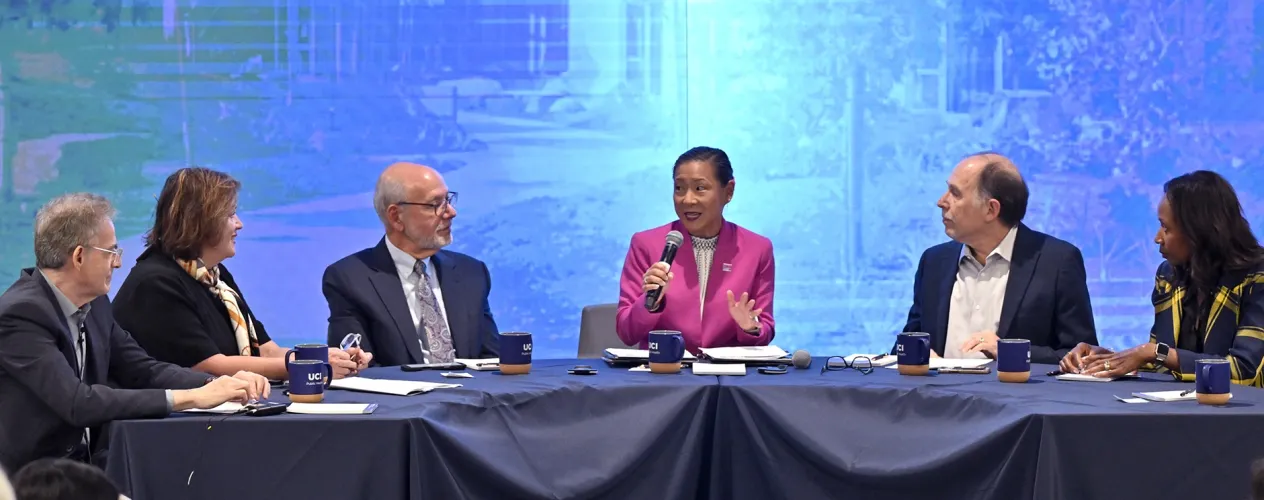
As the nation confronts rising chronic disease, climate-driven health emergencies, and deepening political polarization, the University of California convened its top public health leaders at UC Irvine for a rare, unfiltered assessment of the state of public health in America. Their consensus was stark: we are living through one of the most consequential shifts in public health science and governance in modern history.
The event, hosted by the UC Irvine Joe C. Wen School of Population & Public Health, brought together deans and program directors shaping public health education across California, including Brad Pollock (UC Davis), Ron Brookmeyer (UCLA), Mark Wolfson (UC Riverside), Michael Lu (UC Berkeley), and Cheryl Anderson (UC San Diego), moderated by Deena McRae, UC Health associate vice president.
Following opening remarks from UC Irvine Provost Hal Stern and a state-of-the-field overview from founding dean Bernadette Boden-Albala, the panel outlined a set of escalating national threats:
- Historic federal budget cuts that jeopardize maternal health programs, climate-health research, infectious disease surveillance, and chronic disease prevention.
- Sweeping deregulation that strips away environmental and workplace protections heightening exposure to wildfires, air toxins, and climate-related health risks.
- Restructuring at federal agencies that disrupts core data systems and sidelines scientific expertise.
- A dramatic erosion of public trust, worsened by the spread of misinformation and political polarization.
- Coverage instability as states reassess Medicaid eligibility, disproportionately affecting vulnerable populations.
Across the system, UC deans stressed that California is one of the few states strengthening, rather than weakening, public health capacity, investing in infrastructure, climate resilience, community-engaged research, and training future practitioners to navigate disinformation and political headwinds.
The UC deans emphasized that resilient public health systems depend on deep, long-term community relationships. This includes working with trusted community organizations, where a safe space allows researchers to meet people where they are at and optimize their health. All of the UC public health schools and programs have developed sustained partnerships with local organizations and tailored interventions to engage refugee populations, immigrants, and communities with diverse languages and cultural contexts.
International and refugee students are also an important community to support during this tumultuous time because they contribute unique perspectives to public health practice and training. UC schools provide education in refugee health and support for global collaboration. The deans and directors stressed that empowering these students and building community-based trust networks is central to translating science into action and ensuring that public health knowledge reaches those who need it most.
UC public health schools and programs focus on equipping students with skills for resilience, independent thinking, communication, and advocacy preparing them to defend science, navigate shifting funding landscapes, and respond to emerging health crises. Wellness, mindfulness, and self-care are integrated into training, recognizing that healthy practitioners are essential for healthy communities.
Below are on-the-record quotes illustrating the urgency and the opportunity identified by each public health leader
Cheryl Anderson, UC San Diego
“One of the biggest threats to public health today is keeping our citizenry engaged.”
“Public health is why we have clean air… clean water… the ability to exercise safely.”
“It takes on average 17 years before what we learn gets into communities. We want to cut that down.”
Bernadette Boden-Albala, UC Irvine
“We built our school during COVID and Black Lives Matter… we were able to pivot and be responsive.”
“Our mission is to turn on every light, to defend science so that we all are healthier and happier.”
“One day, when it’s very dark out there… those people we’ve trained will come out and vote… and the lights will go on.”
Ron Brookmeyer, UCLA Fielding School of Public Health
“One thing that I am most concerned about is the disinformation and misinformation about public health and science…”
“Once you lose trust, you lose everything.”
“We are trying to improve communication skills… data skills… teamwork… and dialogue across differences.”
Michael Lu, UC Berkeley
“We are living through the spread of misinformation and disinformation… at a time when the country needs to come together to solve problems.”
“There has been disinvestment… dismantling of public health infrastructure.”
“The worst times can also be the best times… we have the opportunity to reimagine healthcare and public health.”
Brad Pollock, UC Davis
“Many of the leaders in the California Department of Public Health have faculty appointments with us… We are very engaged with CDPH.”
“We are dealing with unique problems… wildfires is a big issue for us.”
“Our view of public health is not limited to the United States.”
Mark Wolfson, UC Riverside
“Think about providing public health services… all the way out to the Arizona border.”
“Our region is over half Latino, with many speaking Spanish or Indigenous languages.”
“To solve wicked problems rooted in structural disadvantage, we need interprofessional collaboration.”